Good internal communication gets every person in a company the information they need, in a format they can use, and gives them a real way to answer back. Most programs fall short on that last part.
Sending news is easy. Building a channel that the warehouse team, the field sales rep and the remote analyst all trust is much harder.
Doing it well depends on a handful of decisions: who you are really talking to, which channels fit each group, how much you rely on managers, how you listen, and how you measure what happens after a message goes out.
The sections below take those decisions one at a time. They start with the basic questions and move toward the ones that come up once a company is already communicating and wants better results.
Table of Contents
What does employee communication actually cover?
Ask ten HR directors to define the field and you will get ten slightly different answers. That variety is not a sign of confusion. Academics have debated the scope of the discipline for years.
In a widely cited 2007 paper, Mary Welch and Paul Jackson argued that the field lacked an agreed definition and theory about its mandates, scope and focus. They proposed looking at it through the lens of stakeholders: who communicates with whom, and for what purpose.
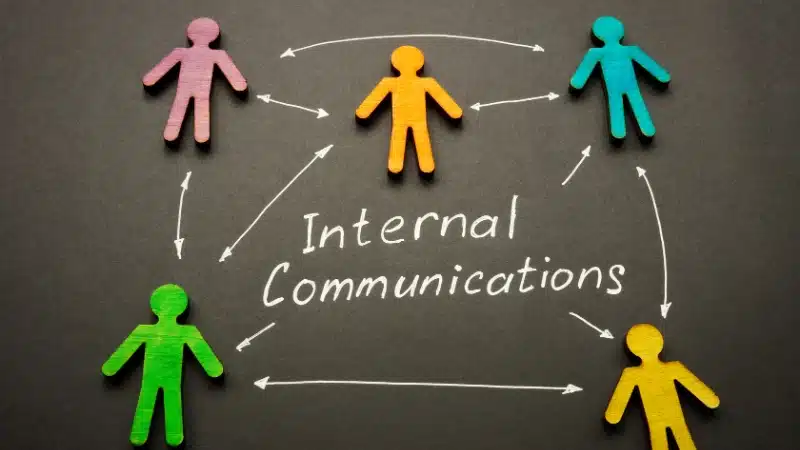
In practice, most companies work with four broad flows of information:
- Top-down messages from leadership: strategy, results, organizational changes, policies.
- Line-manager communication: the daily and weekly exchange between a team leader and the people who report to them.
- Peer-to-peer exchange: colleagues sharing know-how, coordinating shifts or asking questions across departments.
- Bottom-up feedback: surveys, suggestions, questions in town halls and the informal signals employees send about how things are going.
A healthy program pays attention to all four. Many companies invest heavily in the first one, because it is the most visible, and treat the rest as something that will happen on its own. It usually does not.
When a regional sales team in Italy only hears about a new pricing policy through a group email from headquarters, with no chance to ask how it affects existing contracts, the message has technically been delivered. It has not been understood.
Employee communication also overlaps with neighboring areas: employer branding, recognition, onboarding, wellbeing programs and HR self-service.
Those are separate disciplines, but employees experience them through the same screens and the same managers. Treating them as part of one connected employee experience tends to work better than running each through its own channel.
Why is it harder to keep employees engaged right now?
Engagement and communication are not the same thing, and it helps to keep them apart. Engagement, as Gallup measures it, refers to workers’ psychological attachment to their work, their team and their employer.
Communication is one of many factors that shape it, alongside management quality, workload, pay, career prospects and much more. Even so, the engagement numbers explain why so many companies are reviewing how they talk to their people.
According to Gallup’s State of the Global Workplace 2026 report, global employee engagement fell to 20% in 2025, its lowest level since 2020.
The report, published in April 2026 with data collected throughout 2025, estimates the cost to the world economy at about $10 trillion in lost productivity.
Over the longer run, engagement had climbed steadily after 2009, when it stood at 12%, and peaked at 23% in 2022–2023. The 2025 figure followed two consecutive yearly declines.
The sharpest change concerns managers. Global manager engagement stood at 31% in 2022 and had fallen to 22% by 2025, while engagement among non-managers dipped only slightly over the same period, from 20% to 19%.
The biggest single-year drop for managers came between 2024 and 2025, when the figure went down by five points. That matters for communication because managers are the channel most employees rely on to interpret what the company says.
There is a more encouraging signal in the same dataset. Global employee wellbeing, measured as the share of people “thriving,” rose one point to 34% in 2025, and Europe was one of the two regions with the largest increases, at two points. Engagement and wellbeing can move in different directions.
A company can have people who feel reasonably well in their lives while feeling detached from their employer, and that gap is often where clear, honest, two-way communication can help.
For companies facing tight labor markets, these trends connect directly to talent attraction and retention. People who do not understand where the company is going, or who feel nobody listens to them, are easier to lure away.
How does employee communication relate to EU information and consultation rules?
This question comes up often in companies with operations in several European countries, and the two topics are easy to confuse. European law sets rules on employee information and consultation, which are rights linked to employee representation. It does not tell companies which internal channel, app or format to use for day-to-day communication.
The general framework is Directive 2002/14/EC on employee information and consultation, which sets minimum rights across the EU. It entered into force on 23 March 2002, and member states had until 23 March 2005 to transpose it into national law.
The directive leaves the application of those rights to national legislation and industrial-relations practice. As a result, obligations and thresholds differ across Spain, Italy, Portugal, Germany, France and the Netherlands, and there is no single European rule that applies identically in all six.
Larger groups also need to consider Directive 2009/38/EC, which deals with European Works Councils. It aims to improve information and consultation rights in companies and groups operating at Community scale, and it applies to undertakings with at least 1,000 employees in the member states and at least 150 employees in each of at least two member states. Smaller or purely national companies take their obligations from national law instead.
Why does this matter for communication planning? Because a well-designed internal channel does not replace formal consultation with employee representatives where the law requires it. A news post announcing a restructuring is not a consultation process.
The two should be coordinated: representatives informed through the proper procedure, and employees then receiving clear, consistent messages through everyday channels.
Rules vary by country and situation, so any change that affects working conditions or employment should be reviewed with labor law specialists in each jurisdiction before it is announced.
Who are you really talking to?
One of the most useful points in the stakeholder approach is its challenge to the habit of treating employees as one uniform audience.
A company of 3,000 people is not one public. It is a collection of groups with different jobs, schedules, devices, languages and information needs.
A practical segmentation for most European employers looks something like this:
- Office-based staff who spend the day on a laptop and already receive too much email.
- Frontline and deskless workers in stores, plants, warehouses, hospitals or vehicles, who may not have a corporate email address at all.
- Hybrid and remote employees who miss the informal conversations that happen in an office.
- Field sales teams who need fast, practical updates on products, prices, targets and incentives.
- Managers, who are both an audience and a channel.
- New hires in their first months, who need more context than anyone else.
- Employees in different countries, who may need content in several languages and adapted to local practices.
Each group has a different answer to the question “what do I need to know this week?” A shift supervisor in a logistics hub in Germany wants schedule changes and safety notices. A sales manager in Spain wants the new incentive rules and a leaderboard.
A software developer in the Netherlands may care most about product strategy and internal mobility. Sending all three the same newsletter means that much of the content is likely to be irrelevant to many of the readers.
Segmentation does not mean fragmenting the company into silos. Some messages, such as values, strategy, results and major changes, should reach everyone, with the same core content. The difference lies in format, timing and the supporting detail each group receives.
Which channels work, and for what?
No single channel covers every need. The aim is to give each type of message a natural home, so employees know where to look and do not have to check six different tools to stay informed. The comparison below summarizes the most common options.
| Channel | Best suited for | Strengths | Limitations |
|---|---|---|---|
| Formal notices, policy documents, messages that need a record | Familiar, easy to archive | Crowded inboxes; many frontline workers lack an address; hard to measure engagement | |
| Employee portal or intranet | Reference content, HR services, benefits, policies, company news | One place for everything; searchable | Only works if people visit; desktop-only versions exclude deskless staff |
| Mobile employee app | News, alerts, recognition, surveys for distributed teams | Reaches people outside the office; push notifications | Needs clear rules on use outside working hours and data privacy |
| Chat | Quick coordination, team questions, urgent updates | Fast, informal, conversational | Important information gets buried; can create pressure to always be available |
| Town halls and live sessions | Strategy, results, major changes | Human, allows live questions | Hard to schedule across shifts and time zones; needs recordings and follow-up |
| Manager briefings and team meetings | Explaining what a decision means for a specific team | Context and dialogue | Quality varies by manager; messages can be distorted |
| Pulse surveys | Listening at scale, tracking sentiment over time | Fast, comparable data | Survey fatigue if results are not acted upon |
| Digital signage and noticeboards | Shared spaces such as stores, plants and break rooms | Visible without a device | One-way; hard to update across many sites |
Two lessons tend to emerge when companies map their messages onto this table. First, email is usually overused for things that would work better elsewhere, such as celebrating achievements or gathering quick feedback.
Second, frontline teams often depend on channels that are hard to update centrally, like printed notices, which means they receive information later than office staff. Both problems point toward a mobile-friendly, centralized space that everyone can reach.
How do you reach frontline and deskless staff?
For many employers in retail, manufacturing, logistics, healthcare and hospitality, the majority of the workforce does not sit at a desk.
These employees are often the ones customers meet, and they are frequently the last to hear about changes. Fixing that gap is an important move for a communication team.
A few practices make a visible difference:
- Give access without requiring a corporate email address, for example through a mobile app with simple login options.
- Keep messages short and visual. A two-line update with a photo will be read during a break; a three-page memo will not.
- Target by location, role and shift, so a store employee in Lisbon does not receive announcements meant for a plant in Lyon.
- Translate core messages into the languages people actually speak at work.
- Make it easy to respond, with reactions, comments or one-question surveys.
- Agree clear rules on when messages are sent, respecting rest time and local regulations on digital disconnection where they apply.
Want to design effective employee surveys? Find out how Vip Connect can help you customise them and optimise your employees’ experience.
A typical objection at this stage is cost or effort: “Our frontline staff will never download another app.” That concern is reasonable.
Adoption usually depends on giving people something useful from day one, such as payslips, shift information, discounts or recognition from colleagues, rather than just corporate news. When the app saves an employee a trip to the HR office or a phone call, communication rides along with that value.
Another frequent worry is that deskless workers will feel monitored. Being transparent about what data is collected, who sees it and why, and involving employee representatives where national rules require it, helps build trust before launch.
What role should managers play?
Managers translate strategy into daily reality. When a company announces a new commercial priority, employees want to know what it means for their own targets, their schedule and their team. Only their direct manager can answer that credibly.
The fall in manager engagement in 2025, described in Gallup’s data, puts pressure on exactly this link. A disengaged or overloaded manager is unlikely to pass on messages with enthusiasm, or to bring concerns back up the chain.
Companies that rely on managers as their main channel need to support them actively instead of assuming the cascade will work.
Support can take several forms. Give managers information before their teams receive it, so they are not caught off guard. Provide short briefing kits with the core message, likely questions and suggested answers.
Create a space where managers can share what they are hearing from their teams. Recognize managers who communicate well, and include communication in leadership development. None of this requires a large budget. It requires treating managers as a distinct audience with their own needs.
It also helps to reduce the administrative load that pulls managers away from conversations. If a team leader spends hours chasing approvals, forwarding documents or answering the same benefits question repeatedly, there is little time left for the kind of dialogue that builds trust.
How do you turn announcements into a two-way conversation?
Employees who feel heard are more likely to believe what they are told. Listening is not a nice extra; it is half of the job. Yet European workplaces vary widely in how seriously they take it.
The European Company Survey 2019, carried out by Eurofound with Cedefop, found that only around one fifth of EU workplaces combined practices that raise employee autonomy, facilitate employee voice and promote training. Country differences were large.
According to Eurofound’s findings on direct employee involvement, Sweden (56%) and Denmark (55%) led in regular, high-influence direct engagement with employees in 2019, while only around a fifth of establishments in Poland and the Netherlands reached that level.
These are 2019 figures, but they show that genuine employee voice is far from universal, even in mature labor markets.
Practical ways to build that voice include:
- Short, regular pulse surveys with a few questions, instead of one long annual survey that takes months to analyze.
- Open Q&A sessions where leaders answer questions submitted in advance, including anonymous ones.
- Comment and reaction features on company news, so employees can respond publicly.
- Suggestion channels with visible follow-up, showing which ideas were adopted and why others were not.
- Team-level conversations after each survey, where managers discuss results with their people.
The most common failure is asking for feedback and then going silent. When employees answer a survey and never hear what changed, the next survey gets fewer responses and more cynical answers. Closing the loop, with a simple “you told us, we did” message, is an important part of the process.
Eurofound’s European Working Conditions Survey 2024, its eighth edition, covers 35 European countries and is based on more than 36,600 face-to-face interviews.
Large public surveys like this are useful for benchmarking context, but nothing replaces asking your own people directly and regularly.
How do recognition and incentives fit into communication?
Recognition is a form of communication. Every time a company publicly thanks someone for a specific behavior, it tells the whole workforce what it values.
A “thank you” that describes exactly what a colleague did, and links it to a company value, communicates culture more effectively than a poster in the hallway.
This is why many companies connect recognition and rewards with their news channels. Peer-to-peer recognition, visible on a shared feed, helps people in different locations learn about each other’s work.
It also gives frontline employees, who rarely appear in corporate newsletters, a chance to be seen. For a retail chain operating in several countries, a store team in Portugal that receives public praise for a customer service initiative can inspire similar efforts elsewhere.
Sales teams deserve a specific mention. Commercial staff respond to clear targets, timely information about performance and incentives they understand.
Communication for this group works best when it is frequent, concrete and tied to results: campaign launches, product updates, rankings, rules for incentive programs and recognition of top performers.
When incentive rules are explained poorly or scattered across documents, motivation drops and disputes multiply.
Benefits and discounts also send a message. A company that makes its employee benefits easy to find and use is showing that it cares about people’s everyday lives, which supports wellbeing goals and strengthens the employer brand.
When the same benefits are hidden in a PDF on an old intranet, most employees never use them, and the investment communicates very little.
How do you cut tool sprawl without losing reach?
A frequent complaint from HR and communication teams is the sheer number of tools: one for news, another for surveys, a third for recognition, separate portals for benefits and payslips, plus chat, email and a shared drive.
Each tool has its own login, its own updates and its own reports. Employees get lost, and the team spends its time on manual tasks instead of strategy.
Consolidation starts with an inventory. List every channel and tool in use, who owns it, who uses it and what it costs. Then ask, for each one, which employee need it serves and whether another tool already covers it. In many companies this exercise reveals overlaps and abandoned channels that nobody has formally retired.
The goal is not necessarily a single tool for everything, but a single entry point. Employees should be able to open one place and reach news, colleagues, benefits, recognition, surveys and HR services without hunting for links.
Behind that entry point, the company can keep specialized systems such as payroll or performance management, as long as access feels unified.
A centralized approach also simplifies data. When news reach, survey results, recognition activity and benefits usage live in one environment, communication teams can see patterns that are invisible across separate tools, such as whether teams that use recognition more also respond more to surveys.
How do you measure whether communication is working?
Counting messages sent tells you very little. Useful measurement looks at whether people received the information, understood it and acted on it, and whether they feel able to speak up. A sensible set of indicators includes:
- Reach: the share of employees who opened or viewed a message, broken down by location, role and device.
- Active use: how many employees use the main channel each week or month.
- Participation: reactions, comments, survey response rates and recognition activity.
- Understanding: short checks after major announcements, asking whether people know what the change means for them.
- Sentiment: pulse survey results over time, especially on trust, clarity and feeling heard.
- Business-linked indicators: voluntary turnover, absenteeism, benefits uptake and, for sales teams, progress against targets.
No single number captures everything, and correlation is not causation. If voluntary turnover falls after a new communication program, many other factors may be at play. Still, tracking these indicators together, and reviewing them in regular dashboards, lets a company spot problems early.
A sudden drop in reach among night-shift workers, for example, may indicate a scheduling issue with notifications rather than a lack of interest.
Turnover deserves particular attention because it has a direct cost. Estimating that cost for your own company, using your own salary, hiring and training data, makes it easier to have a grounded conversation with finance about investments in employee experience.
A practical 90-day plan to improve employee communication
Large transformations often stall. A focused 90-day plan produces visible progress and builds the case for the next phase.
- Weeks 1–2: audit. Map every channel, audience and recurring message. Ask a sample of employees in different roles where they get information and what they miss.
- Weeks 3–4: define audiences and priorities. Agree on segments, the messages each one needs and the main channel for each type of content.
- Weeks 5–6: prepare managers. Share the plan with team leaders first, give them briefing materials and ask for their input.
- Weeks 7–8: launch or reorganize the central channel. Make sure it works on mobile, includes useful services and reaches frontline staff.
- Weeks 9–10: start listening. Run a short pulse survey and hold a Q&A session with leadership.
- Weeks 11–12: close the loop and measure. Share what you learned and what will change, then review reach, participation and sentiment data to set goals for the next quarter.
Throughout the plan, coordinate with employee representatives where they exist and check country-specific obligations for any announcement that affects working conditions. A plan that respects formal consultation processes avoids conflicts that can undermine trust in every channel.
Where an all-in-one platform fits
At Vip District by Epassi, we design digital, flexible solutions that bring companies and their people closer. Our all-in-one employee engagement platform brings 360° employee communication together with recognition and rewards, employee benefits and discounts, and sales team motivation in a single employee portal, personalized with each company’s brand and adapted to each company’s needs.
Vip Connect, Vip Chat, Vip Directory and Vip Pulse cover the communication and listening side, while Vip Awards and Vip Incentives connect recognition and commercial performance to the same space. To help build the business case, we also offer an ROI calculator and a turnover rate calculator.
Frequently asked questions
What is the difference between employee communication and employee engagement?
Communication is how information and dialogue flow within a company. Engagement describes how psychologically attached people feel to their work, team and employer.
Good communication can support engagement, but engagement also depends on management, workload, pay, development and culture.
Treat engagement figures as context for your communication strategy, not as a direct score of how well you communicate.
Do European rules require a specific channel for communicating with employees?
No. EU directives set minimum rights to information and consultation, mostly linked to employee representation, and national law determines how they apply. They do not prescribe an app, intranet or newsletter for everyday communication.
Formal consultation obligations still need to be respected through the proper procedures in each country, so check with a labor law specialist before announcing changes that affect employment or working conditions.
How often should we communicate with employees?
Frequency depends on the audience and the content. Sales teams and frontline staff often benefit from short, frequent updates, while strategic messages work better in monthly or quarterly formats with room for questions.
Watch reach and participation data: if engagement with messages drops, you may be sending too much or targeting too broadly.
Getting managers to communicate better starts with a few concrete changes.
Brief them before their teams, give them ready-to-use materials, reduce their administrative load and create a channel for them to share feedback upward.
Include communication skills in leadership development and recognize managers who do it well. Managers are an audience with their own needs, not only a relay.
Should recognition be public or private?
Both have a place. Public recognition shows the whole company which behaviors matter and helps people in different locations learn about each other’s work.
Some employees prefer private appreciation, so it helps to offer options. What matters most is that recognition is specific, timely and connected to company values.
How do we avoid survey fatigue?
Keep pulse surveys short, explain why you are asking, share results quickly and show what changed as a result.
Fatigue usually comes less from the number of surveys than from the feeling that answers disappear without consequence.
Can one platform replace all our existing tools?
Depending on your setup, it can replace some of them and provide a single entry point for the rest.
Systems such as payroll may remain separate, but employees can access news, benefits, recognition, surveys and HR services from one place.
The right scope depends on your current setup and contracts, which is why an audit of existing tools is a sensible first step.
If you want to see how news, listening, recognition and benefits can work together in one branded space that reaches every employee, you can request a demo of our platform and talk with our team about the priorities of your own workforce.
New to Vip District? Contact us and find out what our platform has to offer!